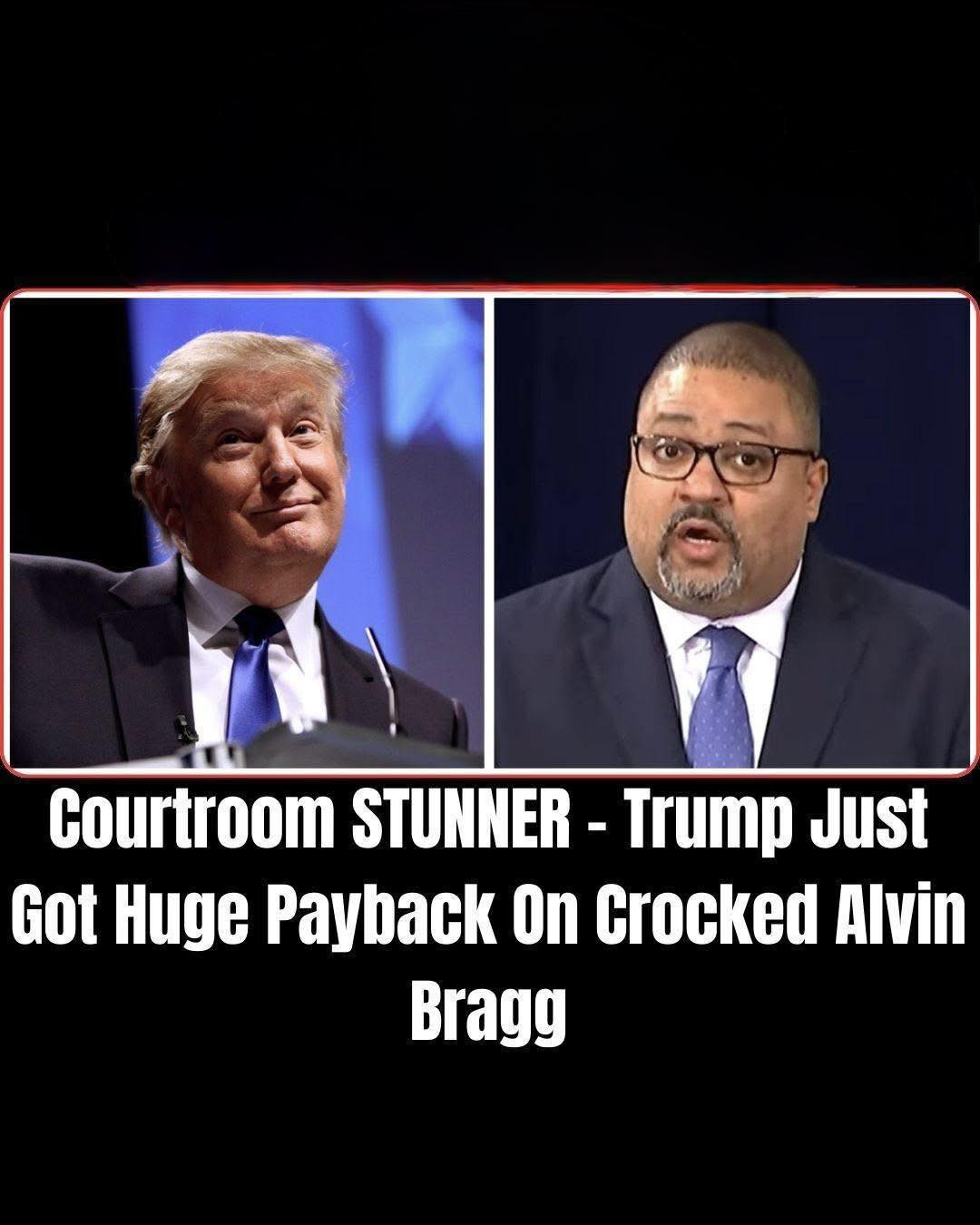
In a development that could reshape one of the most politically charged cases in modern American history, the Second Circuit Court of Appeals ruled on Thursday that a lower court must reconsider former President Donald Trump’s request to move his New York “hush money” criminal case from state court to federal court.
The decision is a significant procedural win for Trump and represents the latest twist in a legal saga that has spanned nearly a decade. The case, initially brought by Manhattan District Attorney Alvin Bragg, accused Trump of falsifying business records related to payments made in 2016 to adult film actress Stormy Daniels. Prosecutors argued the payments were part of a broader scheme to influence the outcome of the 2016 presidential election by concealing damaging information from voters.
Trump was convicted in May 2024 on all 34 felony counts. It was the first criminal conviction of a former U.S. president, a verdict that sparked both celebration and outrage depending on political perspective. But now, with the appellate court’s decision, the question of whether that trial even took place in the correct jurisdiction is back on the table.
How We Got Here
The original case rested on allegations that Trump’s business empire falsified records to disguise payments made to Daniels as “legal expenses.” Prosecutors claimed that the payments, funneled through Trump’s then-personal lawyer Michael Cohen, were effectively hush money to keep Daniels from publicly discussing an alleged affair just weeks before the 2016 election.
Throughout the trial, Trump’s defense maintained that the payments were personal and unrelated to his campaign, framing them as an effort to avoid embarrassment rather than to mislead voters. The Manhattan jury disagreed, convicting him on every count after a month-long trial that dominated national headlines.
Trump’s legal team immediately began pursuing multiple appeals, challenging not only the verdict but also the very foundation of the prosecution. Their central argument has long been that Trump, as a sitting or former president, should have certain protections when legal cases intersect with his official duties. That argument gained renewed strength after the Supreme Court’s landmark ruling in Trump v. United States (2024), which expanded the definition of presidential immunity.
The Supreme Court Shift
The July 2024 Trump v. United States decision redefined how courts should interpret the actions of a sitting or former president. In that case, the Court ruled that presidents are entitled to absolute immunity from criminal prosecution for official acts performed while in office, though they can still be held liable for purely private conduct.
The ruling forced lower courts to reconsider what qualifies as “official” versus “private” — a distinction that has become increasingly blurred in Trump’s ongoing cases.
Citing the new precedent, Trump’s attorneys filed a renewed motion to remove his hush money case from New York state court to federal court, arguing that some of the alleged conduct — including internal communications, statements to federal agencies, and campaign-related directives — could fall under the category of official presidential acts.
However, U.S. District Judge Alvin Hellerstein rejected that motion in September 2024, calling it “untimely” and lacking sufficient cause for reconsideration. Trump’s lawyers appealed, claiming the lower court had ignored the profound implications of the Supreme Court’s ruling.
The Second Circuit’s Decision
On Thursday, the Second Circuit Court of Appeals agreed that the lower court’s analysis was incomplete. In its written opinion, the three-judge panel vacated Judge Hellerstein’s decision and ordered a reconsideration of Trump’s motion.
“We cannot be confident that the District Court adequately considered issues relevant to the good cause inquiry so as to enable meaningful appellate review,” the judges wrote.
“Those issues include, but are not limited to, the impact of Trump v. United States on the removability of the underlying state prosecution.”
The appellate judges specifically instructed the lower court to examine whether evidence admitted during the state trial related to actions that might be covered under presidential immunity — and, if so, whether that would transform the nature of the prosecution into one involving acts performed “under color of the presidency.”
The opinion also raised a broader procedural question: whether a motion to remove a criminal case to federal court must always be filed before trial, even if new legal grounds — such as a major Supreme Court ruling — emerge afterward. The appellate court stopped short of answering that question directly, instead leaving it for the lower court to determine.
What This Means For Trump
While Thursday’s ruling does not overturn Trump’s conviction, it reopens the door to a potential reversal. If the district court ultimately agrees that the state trial should have been held in federal court, Trump’s conviction could be vacated and the case potentially re-litigated in a new venue.
Legal analysts say that outcome remains a long shot but is far from impossible.
“Trump’s team doesn’t need to prove that he’s innocent to win here — they just need to prove the trial took place in the wrong courtroom,” said Robert Klein, a former federal prosecutor now teaching at NYU School of Law. “If the Second Circuit’s concerns about jurisdiction are validated, that’s a procedural bombshell.”
For Trump, the stakes extend well beyond this particular case. A successful appeal could bolster his broader legal defense in other ongoing cases — including investigations related to election interference and classified documents — by reinforcing the argument that certain actions were taken in his official capacity as president.
Political and Legal Ripples
The decision comes at a politically charged moment. Trump, now serving his second term as president, has frequently criticized what he calls “politically motivated prosecutions” brought against him by state and federal officials. The hush money case, in particular, has long been cited by his supporters as an example of overreach by local prosecutors.
Meanwhile, Manhattan District Attorney Alvin Bragg has stood by the integrity of his case, describing the conviction as “a victory for transparency and accountability.” His office declined to comment on the appellate ruling but is expected to argue vigorously against transferring the case to federal court.
Legal observers say the ruling underscores the increasingly complex overlap between state and federal authority in politically sensitive prosecutions — especially when a former or sitting president is involved.
“It’s a constitutional gray zone,” said Laura Sanders, a constitutional law expert at Columbia University. “The courts are being forced to define, often for the first time, where the line between political accountability and criminal liability actually lies.”
What Happens Next
The case now returns to the U.S. District Court for the Southern District of New York, where Judge Hellerstein will be required to reassess Trump’s motion in light of the appellate guidance. Both sides are expected to submit new legal briefs over the next several weeks, and oral arguments could be scheduled before the end of the year.
If the lower court determines that the case should have been moved to federal court, it could trigger a lengthy process involving new motions, hearings, and possibly even a retrial under federal oversight.
Until then, Trump’s conviction technically remains in effect — but the path to overturning it is clearer than it has ever been since the 2024 verdict.
As one legal analyst summarized, “This is not an exoneration, but it’s a door reopened — and for Donald Trump, that’s all he needs to keep fighting.”