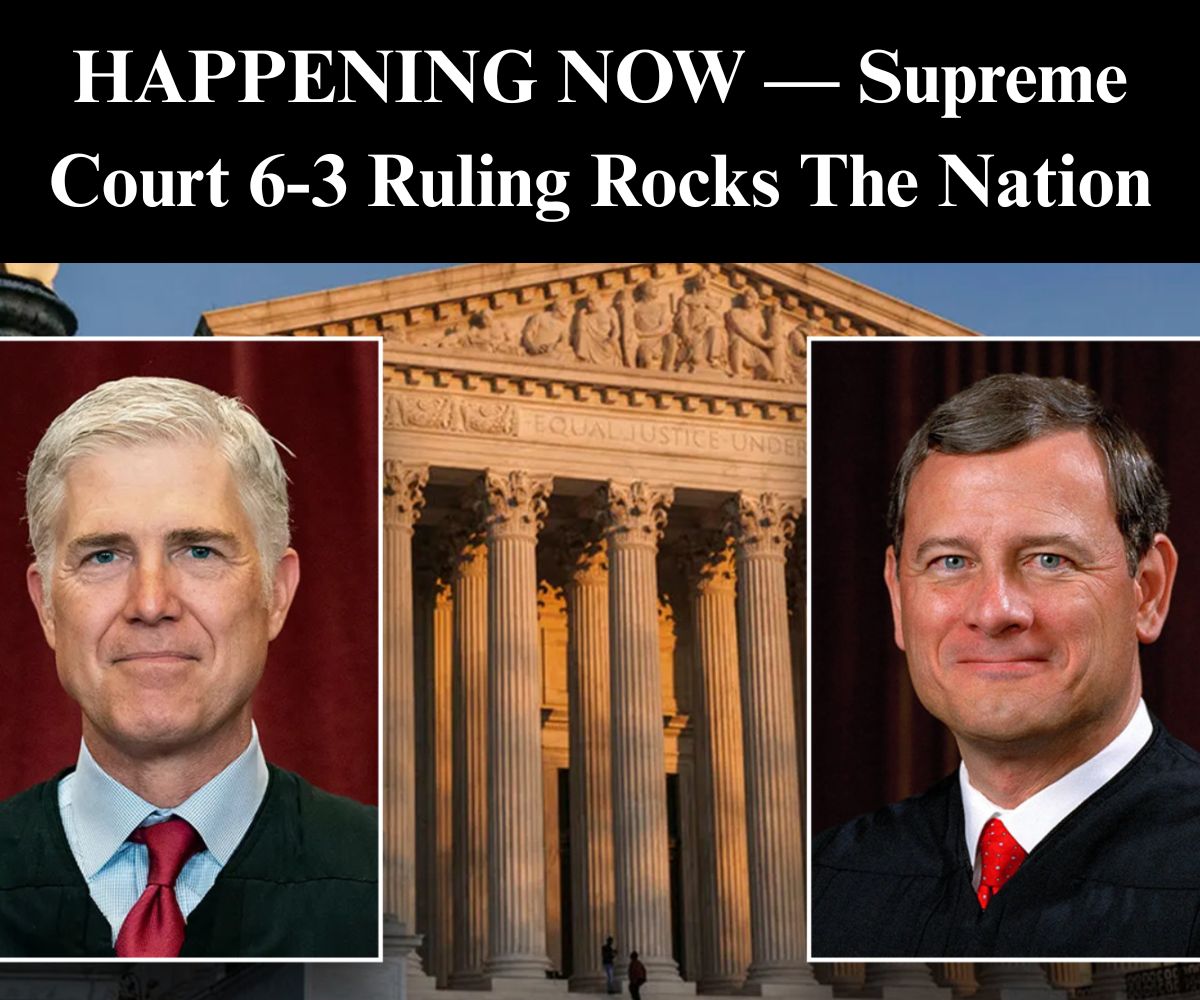
The U.S. Supreme Court declared Thursday that South Carolina has the authority to prohibit Medicaid financing for Planned Parenthood clinics, in a technical interpretation of healthcare options that has evolved into a bigger political battle over abortion access.
The case, Medina v. Planned Parenthood South Atlantic, is about whether low-income Medicaid patients can sue under Section 1983 of the Civil Rights Act of 1871 to pick their qualified healthcare provider. It concerns South Carolina’s denial of Medicaid money to Planned Parenthood South Atlantic, which the organization claims violates federal law.
In a 6-3 ruling, the Court stated that the customary punishment for such a breach would be for the Secretary of Health and Human Services to remove Medicaid money from the state, rather than a person suing the state.
“Section 1983 permits private plaintiffs to sue for violations of federal spending-power statutes only in ‘atypical’ situations … where the provision in question ‘clear[ly]’ and ‘unambiguous[ly]’ confers an individual ‘right,’” Justice Neil Gorsuch wrote in the majority opinion, ruling that the law in question in the present case “is not such a statute.”
“After all, the decision whether to let private plaintiffs enforce a new statutory right poses delicate questions of public policy,” Gorsuch added. “New rights for some mean new duties for others. And private enforcement actions, meritorious or not, can force governments to direct money away from public services and spend it instead on litigation. The job of resolving how best to weigh those competing costs and benefits belongs to the people’s elected representatives, not unelected judges charged with applying the law as they find it.”
South Carolina Gov. Henry McMaster has been attempting to prevent public health monies from coming to Planned Parenthood, but a resident and patient at Planned Parenthood South Atlantic claimed that doing so violated her Medicaid rights.
The essential element of the 1965 Medicaid Act ensures patients have a “free choice of provider” who is willing and qualified. Much of the debate centered on whether Planned Parenthood was a “qualified provider” under the Medicaid bill, as well as whether individual patients have a clear “right” to sue to see their preferred provider, according to the law’s text.
Justice Ketanji Brown Jackson, supported by Justices Sonia Sotomayor and Elena Kagan, wrote in the dissent that the approach used by South Carolina and the Court’s majority was “a narrow and ahistorical reading” of Section 1983.
Federal law already prevents Medicaid funds from being used to fund abortions, with very few exceptions. With few exceptions, South Carolina prohibits most abortions at six weeks after conception or when fetal heart activity is detected.
Medicaid individuals in South Carolina frequently seek treatment at Planned Parenthood since it takes publicly financed insurance. Blocking the provider from Medicaid networks may essentially defund it.
According to the Associated Press, South Carolina has only two Planned Parenthood clinics, but they serve hundreds of low-income patients each year for reproductive health services like as contraception, cancer screenings, and pregnancy tests.
Planned Parenthood South Atlantic has claimed that the issue is not abortion, but rather access to general healthcare.
The case dates back to 2018, when McMaster issued an executive order directing the South Carolina Department of Health and Human Services (DHHS) to remove abortion clinics, including Planned Parenthood South Atlantic (PPSAT), from the state’s Medicaid provider list. The governor said that Medicaid funding for the state’s two Planned Parenthood facilities amounted to taxpayers supporting abortions.
The move effectively prevented low-income patients from accessing other PPSAT treatments in Columbia and Charleston, including gynecological examinations, birth control, cancer screenings, and testing and treatment for sexually transmitted infections (STIs). Lower courts had placed the order on hold, resulting in the current case.
The conservative nonprofit Alliance Defending Freedom has stated that even if South Carolina wins, Medicaid patients would be able to use one of the state’s 200 other publicly financed healthcare clinics.
The Fourth Circuit Court of Appeals previously agreed with Planned Parenthood, holding that Medicaid patients may sue for the legal right to pick their qualified provider, a decision that the Supreme Court eventually overturned.